What Is a VPN? How It Works and Whether You Need One
A VPN (virtual private network) is an app that encrypts your internet traffic and sends it through a server run by the VPN company. Websites see the server's IP address instead of yours, and your internet provider or the Wi-Fi owner can't see which sites you visit. It protects your privacy, but it doesn't make you anonymous.
We may earn a commission when you buy through links on this page, at no extra cost to you. How we make money
 Partner offer
VPNs in 30 seconds
It encrypts
Everything between your device and the VPN server is scrambled, so the network in between can't read it.
It hides your IP
Sites and apps see the VPN server's address and location, not yours.
It protects on public Wi-Fi
Hotel, café and airport networks can't see what you do.
It isn't anonymity
Accounts, cookies and fingerprinting can still identify you.
It moves trust
The VPN company can see your traffic instead of your internet provider, so pick an audited one.
It costs a little speed
Usually unnoticeable with a modern protocol and a nearby server.
How does a VPN work?
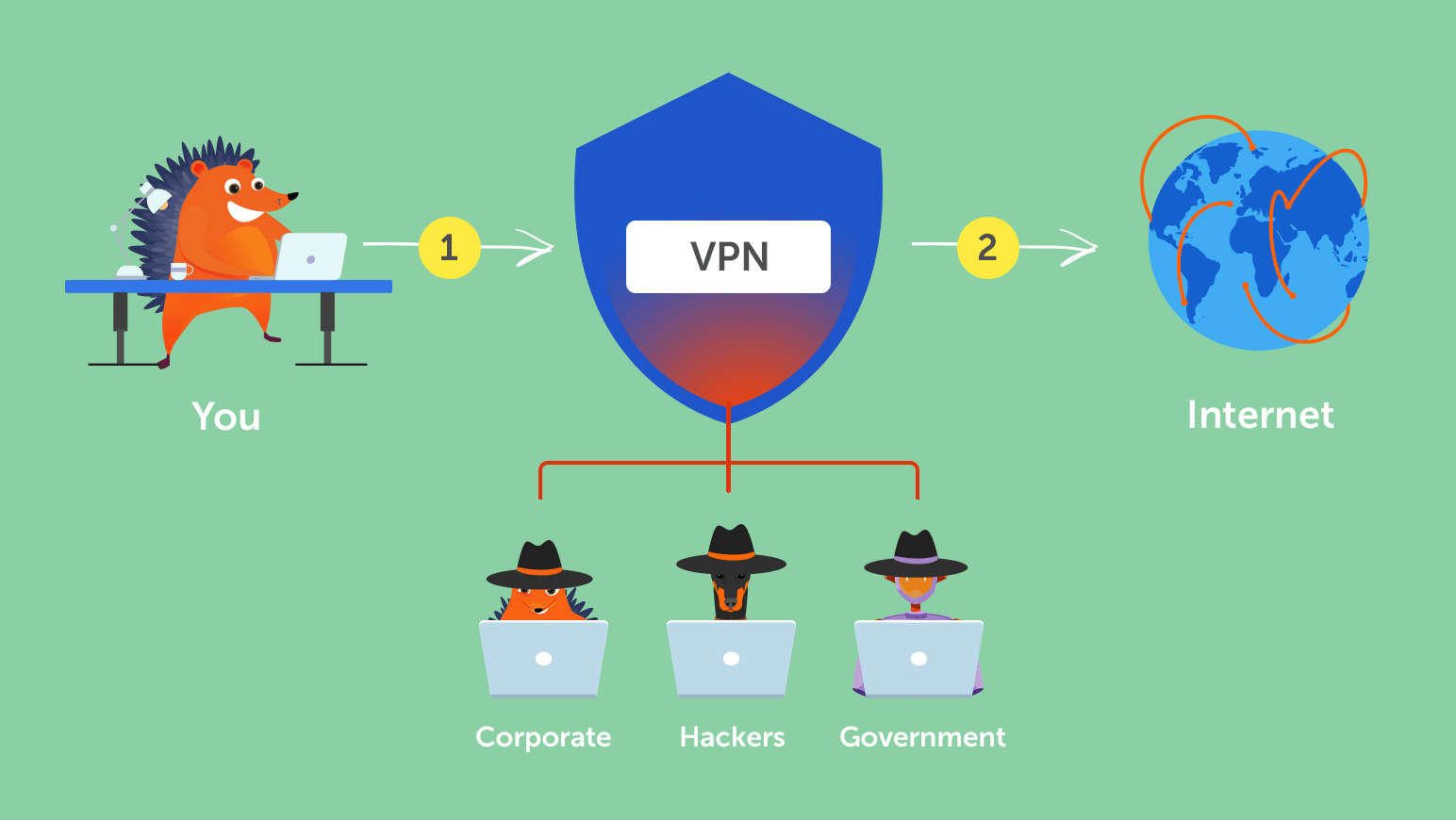
A VPN builds an encrypted tunnel between your device and a VPN server, then sends your traffic out to the internet from there. Here's what happens when you press connect:
- The app connects to a VPN server you choose, for example in your own country or abroad, and the two agree on encryption keys.
- Your device encrypts everything it sends before it leaves, using strong ciphers such as AES-256 or ChaCha20.
- Your internet provider or Wi-Fi network carries the encrypted data to the VPN server. It can see that you use a VPN, but not what's inside.
- The VPN server decrypts the traffic and forwards it to the website or app, using its own IP address.
- Replies travel back the same way, encrypted from the VPN server to your device.
VPN protocols, briefly
The protocol is the set of rules for building the tunnel. WireGuard is the modern standard: fast, lean and well reviewed. Several providers build their own on top of it or alongside it, such as NordVPN's NordLynx and ExpressVPN's Lightway. OpenVPN is older and slower but very flexible, and IKEv2 reconnects well on phones. In practice, leave your app on its default fast protocol.
What a VPN can and can't protect
Most disappointment with VPNs comes from expecting things they were never built to do. On mobile, scroll the table sideways.
| A VPN does | A VPN doesn't |
|---|---|
| Hide which sites you visit from your internet provider and Wi-Fi owner | Hide what you do from sites you're logged in to, such as Google or Facebook |
| Replace your IP address and location for every app | Stop cookies, trackers or browser fingerprinting on its own |
| Protect your traffic on public and shared Wi-Fi | Protect you from phishing pages, scam messages or malware downloads |
| Keep your IP private from other torrent peers and game players | Make illegal downloads or other illegal activity legal |
| Help on networks that block certain sites or apps | Guarantee access in countries that actively block VPNs |
| Show your home streaming catalogue while traveling, in many cases | Promise every streaming service will work; many block VPN servers |
Some VPNs add tools like ad and malware blocking, which cover part of the right-hand column. Those are extras on top of the VPN itself.
Do you need a VPN?
You probably benefit from one if any of these apply to you:
You use public Wi-Fi often. Hotels, airports, cafés and campuses are where a VPN adds the most protection. See our travel VPN guide.
You want privacy from your internet provider. In some countries, including the US, internet providers are allowed to use browsing data for advertising.
You torrent or play online. A VPN keeps your IP private from other peers and players. See our torrenting and gaming guides.
You travel and want your usual services. A server at home can help with banking and streaming abroad, though some services block VPNs.
You're on a network that blocks things. School, office and some national networks restrict sites and apps.
You may not need one if you mostly browse at home on secure HTTPS sites and don't mind your internet provider seeing which sites you visit. HTTPS already protects passwords and card details in transit, so a VPN is about privacy and control, not basic safety.
Types of VPN
| Type | What it's for | Who uses it |
|---|---|---|
| Personal (consumer) VPN | Privacy, public Wi-Fi, travel, streaming and torrenting | Individuals and families, e.g. NordVPN, Surfshark |
| Remote-access business VPN | Lets employees reach company systems securely from home | Companies and their staff |
| Site-to-site VPN | Joins two office networks over the internet | Businesses with several locations |
| Router VPN | Covers every device on your Wi-Fi, including TVs and consoles | Households, gamers |
| Browser VPN extension | Protects only the browser, often as a proxy | Quick IP changes in one browser |
When people say "a VPN", they almost always mean a personal VPN app. That's what the rest of this guide covers.
VPN vs proxy vs Tor
| VPN | Proxy | Tor | |
|---|---|---|---|
| Encrypts your traffic | Yes, all of it | Usually not | Yes, in several layers |
| Covers | Every app on the device | One app or browser | The Tor Browser |
| Speed | Fast | Fast | Slow |
| Who you trust | The VPN company | The proxy operator | No single operator |
| Best for | Everyday privacy, Wi-Fi, travel, streaming | Quick IP changes, some torrent clients | Maximum anonymity, slow browsing |
How to choose a good VPN: 7 checks
- An independently audited no-logs policy. Look for a published audit by a recognised firm, ideally repeated. Court cases or server seizures that found nothing are even stronger evidence.
- A kill switch that blocks your connection if the VPN drops, so your real IP never leaks.
- A modern protocol such as WireGuard or a provider's own fast protocol built for it.
- RAM-only servers, which wipe data on every restart.
- Enough devices for your household; plans range from 10 devices to unlimited.
- Servers where you need them, near you and in any country you want to appear in.
- A money-back guarantee and honest renewal pricing. Most premium VPNs give 30 days; check what the plan costs after the first term.
How to set up a VPN
- Choose a VPN and a plan. Long plans cost less per month; start within the money-back window.
- Download the app from the provider's site or your app store, and log in.
- Turn on the kill switch and auto-connect in the settings.
- Connect to a server. Pick a nearby one for speed, or one in another country to appear there.
- Check it works with our What is my IP tool: it should show the VPN server's location, not yours.
Are VPNs legal?
VPNs are legal in most countries, including the US, UK, Canada, Australia and the EU. A few countries restrict them, and using a VPN never makes an illegal activity legal.
China only formally allows government-approved VPNs and blocks many others. See our VPN for China guide.
Russia doesn't ban using a VPN outright, but it blocks hundreds of VPN services and fines people for searching for banned material through one.
The UAE allows VPNs for legitimate uses, but misusing one to commit or hide a crime can bring very large fines and prison.
Rules change, so check official advice before you travel. Our travel VPN guide covers this in more detail. Treat this as an overview rather than legal advice.
Are free VPNs safe?
Some are, many aren't. Running a VPN costs money, so a free service has to pay for itself somehow.
A few reputable providers offer limited free plans funded by their paid customers, with no ads and no data selling; expect fewer servers, slower speeds or data limits. Many other free VPN apps make money from ads or user data, lack a kill switch, or have never been audited. If a free VPN won't say how it makes money or who audits it, don't trust it with all your traffic.
For regular use, a paid VPN with an audited no-logs policy and a 30-day refund is the safer and usually faster choice.
Common VPN myths
Myth: "A VPN makes me completely anonymous." It hides your IP and encrypts traffic, but logins, cookies and fingerprinting can still identify you.
Myth: "VPNs are only for hackers or pirates." Businesses, journalists, travelers and ordinary people use them for privacy and security every day.
Myth: "A VPN will make my internet much slower." Modern protocols lose little speed on nearby servers; distance matters more than the VPN itself.
Myth: "A VPN protects me from viruses." A VPN doesn't scan files. You still need safe browsing habits and antivirus software.
Myth: "All no-logs VPNs are the same." Only some have had their claims independently audited. That's the most important difference.
VPNs we recommend in 2026
Picked on audits, features and value. Read the full review for the details, or see our best VPNs of 2026 ranking.
VPN questions answered
What is a VPN in simple terms?
A VPN (virtual private network) is an app that sends your internet traffic through an encrypted tunnel to a server run by the VPN company. Websites see the server's IP address instead of yours, and your internet provider or the Wi-Fi owner can't see which sites you visit.
Does a VPN make me anonymous?
No. A VPN hides your IP address and encrypts your traffic, but websites can still identify you through accounts you log in to, cookies and browser fingerprinting. The VPN company can also see your traffic, which is why an independently audited no-logs policy matters.
Does a VPN hide my browsing from my internet provider?
Yes. With a VPN on, your internet provider can see that you're connected to a VPN and how much data you use, but not which websites you visit or what you do on them.
Do I need a VPN at home?
It depends on what you want. At home, a VPN is useful for keeping your browsing private from your internet provider, torrenting, or reaching your home streaming catalogue while traveling. For basic security, HTTPS websites and a secure router already do a lot.
Is it legal to use a VPN?
VPNs are legal across most of the world, including the US, UK, Canada, Australia and the EU. China, Russia and the UAE restrict or police them in different ways, and a handful of countries ban them. Whatever the country, a VPN never turns an illegal act into a legal one.
Does a VPN slow down my internet?
A little. Encryption and the extra distance to the VPN server cost some speed and add some delay. With a modern protocol such as WireGuard and a nearby server, most people don't notice it for browsing, streaming or video calls.
Are free VPNs safe?
Some are, but many aren't. A few reputable providers offer limited free plans with no ads or data selling. Many other free VPN apps make money from ads or user data, lack a kill switch, or have never been audited.
What is the difference between a VPN and a proxy?
A proxy changes the IP address for one app or browser but usually doesn't encrypt your traffic. A VPN encrypts all traffic from your device and changes your IP for every app, which makes it the safer choice on public Wi-Fi.
Can I use a VPN on my phone?
Yes. All major VPNs have apps for iPhone and Android, and one subscription usually covers 10 or more devices, so you can protect your phone, laptop and tablet together.
Related guides
Ready to try a VPN?
NordVPN is the safest place to start, and Surfshark is the budget option with no device limit. You get 30 days with either to ask for your money back.